
By this point, you should already understand that this strategy has the potential to generate consistent profits under the right conditions.
The next question is:
What kind of trading rules allow this approach to work long term?
In this chapter, I’ll explain the overall structure and core logic of the strategy.
This is one of the most important sections in the series.
If necessary, revisit it several times before moving on.
Strategy Overview
At its core, the strategy is simple.
- Market: High-volatility assets such as cryptocurrencies
- Method: Place orders at fixed intervals and repeatedly buy and sell as price moves up and down
However, what truly determines the outcome is the design and risk structure behind those rules.
Trading Rule #1: Choosing the Right Asset
The first and most important decision is:
Which asset should you trade?
There are three key conditions.
- The asset should have long-term potential
- Avoid newly listed coins
- The asset must have sufficient volatility
All three are important.
Choose Assets With Long-Term Potential
This strategy is not built around pure short-term speculation.
It assumes the asset will continue to exist and remain actively traded over time.
In crypto markets, many coins move purely because of hype or speculation.
These assets often lose trading activity over time and eventually lose volatility as well.
But this strategy depends on repetition.
Without continuous market movement and liquidity, the strategy cannot function efficiently.
That’s why it’s important to choose assets with:
- A clear development roadmap
- Strong utility or long-term demand
- Ongoing ecosystem growth
- Active development teams
Projects backed by major investors or venture capital firms can also be worth paying attention to.
VC involvement does not guarantee success, but it often suggests that the project has undergone at least some level of professional evaluation.
Avoid Newly Listed Coins
Even if a project looks promising, newly listed assets tend to be highly unstable.
They often have:
- Limited price history
- Extreme volatility driven by hype
- Unpredictable liquidity conditions
Many surge shortly after launch, then remain stagnant for years afterward.
This strategy works best when an asset continues moving up and down over long periods of time.
As a general guideline, it is safer to focus on assets with at least 4–5 years of price history whenever possible.
Also be careful with “next big coin” recommendations commonly seen on YouTube or Instagram.
In many cases, those promotions are driven more by marketing incentives than objective analysis.
Sufficient Volatility Is Essential
Grid trading only works when price moves.
If volatility is too low, profitability drops significantly.
After confirming the first two conditions, the next step is to evaluate how actively the asset moves within a range.
The larger and more frequent the price fluctuations are, the more opportunities the strategy can capture.
Trading Rule #2: Directional Bias
This strategy operates using buy-side positions only.
No short selling is used.
The reason is simple:
The strategy assumes you are trading assets with long-term upside potential.
Prices may decline sharply in the short term, but if the long-term thesis remains intact, the asset should still retain upward potential over time.
This assumption greatly stabilizes both:
- the structure of the strategy
- the trader’s psychology
And psychology matters.
Most trading strategies fail once emotions begin influencing decisions.
Trading Rule #3: Exit Structure
Most traditional grid strategies assume the market will remain inside a range indefinitely.
This strategy is designed differently.
It assumes the range will eventually break upward.
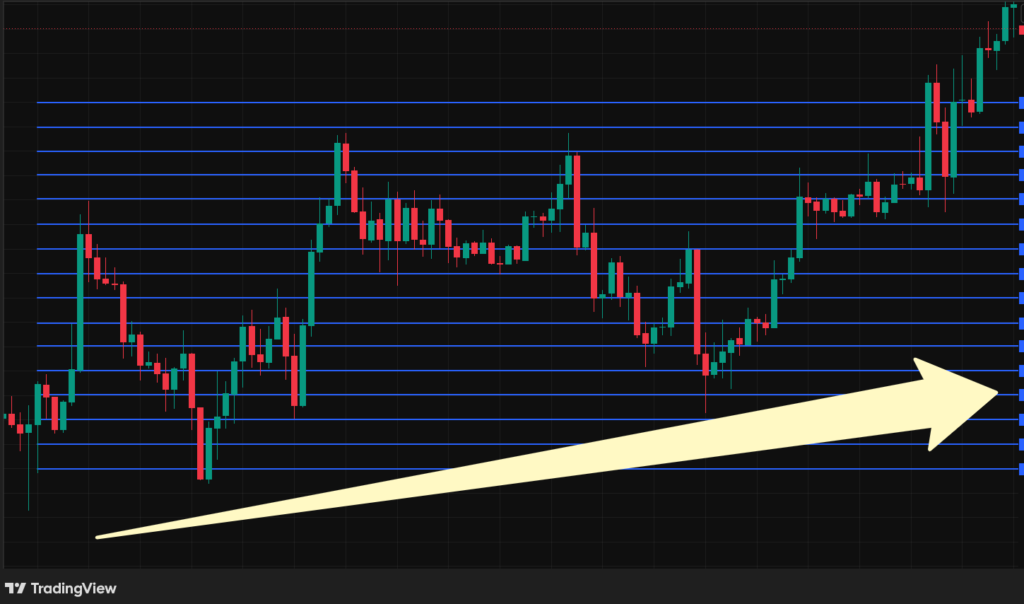
Why?
Because every range eventually breaks.
Ignoring that reality is what causes many grid strategies to collapse over time.
Instead, this approach is structured from the beginning with an upside breakout in mind.
That creates two possible outcomes:
- While price remains inside the range → repeated profit-taking
- When price eventually breaks upward → all positions are closed in profit
This is one of the key ideas behind the strategy.
Many traders struggle because even strong assets move through repeated cycles of fear and optimism before trending higher.
But when the strategy itself is designed to benefit from those fluctuations, even temporary declines become part of the system rather than a threat.
That leads to greater emotional stability — and ultimately, more consistent execution.
What Happens After a Breakout?
When price moves beyond the upper range, there are several possible responses.
- Define a new trading range (without chasing the market excessively)
- Rotate into another promising asset
- Wait for the next opportunity patiently
The important point is this:
The exit condition is defined in advance.
The strategy is not based on emotional decisions made in real time.
What Comes Next
At this point, you should now understand the overall structure of the strategy.
However, two critical elements still remain:
Range Design and Position Sizing.
Even a strong strategy can fail if those are designed poorly.
In the next chapter, we’ll cover how to structure ranges and capital allocation in a way that avoids collapse.